
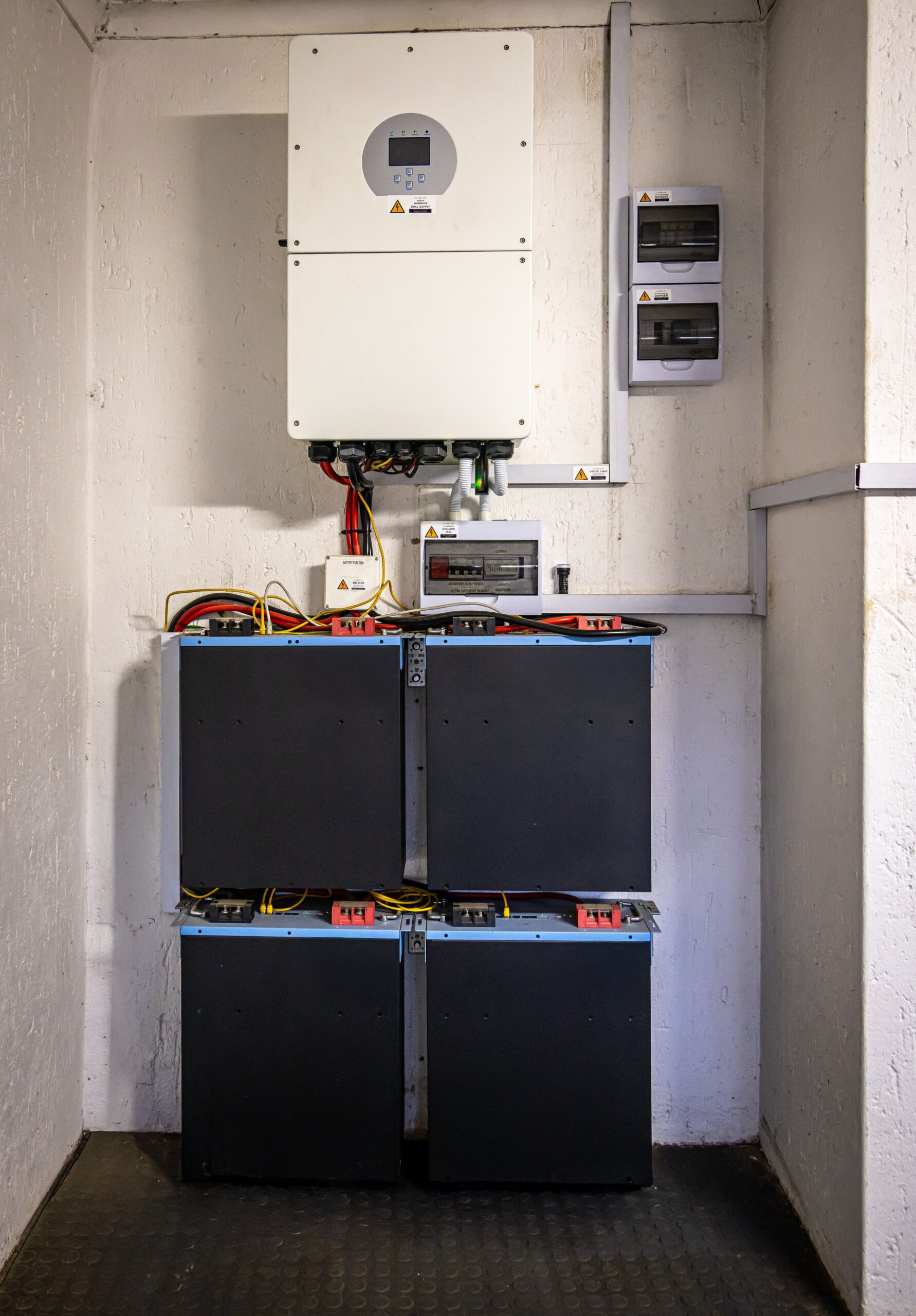
With so many myths and misconceptions about solar batteries, how can you tell whether what a salesperson tells you is true or false?
Some solar companies make batteries sound like an essential part of every solar installation. Others suggest they’re an unnecessary expense. The truth is that a home battery may be a worthwhile investment for one household and a waste of money for another.
A trustworthy solar company should explain the benefits, limitations, costs, and long-term considerations of battery storage so you can decide what makes sense for your home.
For Utah homeowners, there are several important things to understand before making that decision.
- What Does a Solar Battery Actually Do?
Solar batteries can provide several benefits, but it’s important to understand that those benefits aren’t all the same.
Using Your Solar Power at Night
Solar panels generate most of their electricity during daylight hours, when your household may not need all the power being produced.
Without a battery, excess electricity is typically sent to the utility grid in exchange for an export credit. Depending on your utility’s compensation rates, that credit may be considerably less than what you pay to purchase electricity later.
A battery allows you to store some of that excess daytime energy and use it during the evening or overnight, potentially reducing the amount of electricity you need to buy from your utility.
Keeping the Lights On During a Power Outage
A properly configured battery system can provide backup power when the electrical grid goes down.
Depending on the system’s capacity and design, it may power selected essential circuits or much of your home. However, having solar panels does not automatically mean your home will have electricity during an outage. Many grid-connected solar systems shut down when the grid fails unless they have the appropriate backup equipment and configuration.
A solar company should explain exactly what your system can power during an outage, how long it can operate, and whether your panels can recharge the battery while the grid is down.
Reducing Your Electricity Bill
A battery can help reduce electricity costs by storing excess solar energy for use when your household needs it later.
However, the amount you save depends on several factors, including:
Your utility’s electricity rates.
The compensation you receive for electricity exported to the grid.
Your household’s electricity consumption throughout the day.
Battery efficiency and usable capacity.
The cost of purchasing, installing, and maintaining the battery.
For Utah homeowners, utility compensation rules are particularly important. If the credit you receive for exported electricity is relatively low, using more of your own solar energy may be financially advantageous.
Nevertheless, the savings aren’t guaranteed to justify the battery’s additional cost.
Remember: Backup power provides security and convenience, while bill savings provide a financial benefit. A battery may be worthwhile for one reason even if it doesn’t pay for itself through electricity savings alone.
- What Can the Battery Actually Power?
If a salesperson tells you, “This battery will run your house during an outage,” ask for specifics.
Not all batteries provide the same amount of energy or power, and not every system is configured to support an entire home.
Here are four important specifications to understand:
Usable capacity (kWh)
This tells you how much energy the battery can supply. A larger capacity generally allows you to power your home for longer, assuming your electricity consumption stays the same.
Continuous power (kW)
This measures how much power the battery can deliver at one time. It helps determine how many appliances you can operate simultaneously.
Surge power
Some appliances, including certain air conditioners, pumps, and refrigerators, require a brief burst of additional power when starting. Your battery must be capable of handling those demands if you want to run those appliances during an outage.
Backup configuration
Ask whether the system will power your entire home or only selected circuits. Also ask whether it can support major appliances and whether any additional electrical equipment is required.
For example, a battery with 10 kWh of usable capacity could theoretically supply a steady 1 kW load for about 10 hours. Actual operating time will be lower when conversion losses and other system limitations are considered.
A good installer should help you estimate how long your battery could power the appliances you actually intend to use.
- How Long Will the Battery Last?
Like other household equipment, solar batteries don’t last forever. Their capacity gradually declines with age and use, and eventually the battery may need to be replaced.
A reputable solar company should clearly explain the following:
Warranty duration: How long does the manufacturer’s warranty last?
Retained capacity: How much of the battery’s original capacity is guaranteed to remain at the end of the warranty?
Usage limitations: Are there restrictions on charging cycles or total energy throughput?
Repair and replacement: What happens if the battery fails? Are labor and replacement costs covered?
Other equipment: Are the inverter and associated electrical components covered under separate warranties?
Don’t assume that a battery will retain its original capacity throughout its warranty period. Also, don’t assume that the warranty covers every possible repair or replacement expense.
Ask for the actual warranty documents and read the exclusions before signing a contract.
- Ask These Questions Before Buying a Solar Battery
A solar consultation is an opportunity to evaluate the company’s recommendations, not simply listen to a sales pitch.
Take this checklist with you and ask the installer to provide clear answers, preferably in writing.
Financial Questions
Show me the estimated electricity-bill savings with solar alone and with solar plus a battery.
What export-credit rate and utility tariff did you use in your calculations?
What is the battery’s total installed cost, separate from the solar system?
Does your payback calculation account for battery degradation and financing costs?
Performance and Backup Questions
Which circuits will operate during an outage, and for approximately how long?
Can the solar panels recharge the battery during an extended outage?
What are the battery’s usable capacity, continuous power, and warranty terms?
Future Flexibility Questions
Can I install the battery later without replacing the inverter or other major equipment?
The answers should help you compare the actual benefits and costs rather than relying on general promises about what solar batteries can do.
The Bottom Line
A solar battery isn’t automatically a necessity, and it isn’t automatically a waste of money.
For some homeowners, the ability to keep essential appliances running during a power outage is worth the additional expense. For others, a battery may reduce electricity costs enough to justify the investment. Some households may find that installing solar without a battery is the more economical choice.
The important thing is to understand what you’re paying for and what you can reasonably expect in return.
A good solar company won’t simply tell you that you need a battery. It will show you the numbers, explain the trade-offs, answer your questions, and help you decide whether a battery makes sense for your home.
A Utah Example: Do the Numbers Justify a Battery?
Let’s look at a practical example for a homeowner served by Rocky Mountain Power in Utah.
Under the utility’s 2026 net-billing program, eligible newer solar customers receive an export credit of:
- Summer (June–September): 4.855 cents per kilowatt-hour (kWh).
- Winter (October–May): 4.030 cents per kWh.
Utah Clean Energy reports an average residential electricity price of approximately 10.2 cents per kWh for Rocky Mountain Power customers. Your actual rate and the portion of your bill that can be avoided will depend on your rate schedule. These export credits and retail prices should not be assumed to apply to every Utah utility customer.
Now imagine a solar homeowner has excess electricity during the day and wants to use that energy in the evening.
Without a battery, the homeowner exports the excess electricity to the grid and receives the applicable credit. Later, the homeowner purchases electricity from the utility.
With a battery, the homeowner can store some of that excess electricity and use it later instead.
However, batteries lose some energy during charging and discharging. For illustration, let’s assume that for every 1 kWh of excess solar electricity sent into the battery, 0.85 kWh is available to use later.
Using the published rates above, and assuming the stored electricity offsets purchases priced at 10.2 cents per kWh, the approximate benefit of storing rather than exporting that energy would be:
| Calculation per 1 kWh stored | Summer | Winter |
|---|---|---|
| Value of electricity used later | 8.67¢ | 8.67¢ |
| Export credit given up | 4.86¢ | 4.03¢ |
| Approximate additional benefit | 3.81¢ | 4.64¢ |
These figures are illustrative, not a guaranteed savings estimate. They exclude battery costs, degradation, financing, and other charges. Actual savings depend on the homeowner’s applicable electricity charges and how much stored energy is successfully used.
What does this mean in practice?
Even if a battery helps you save money on electricity, the additional savings may be relatively small compared with the battery’s purchase price.
For example, if a battery shifts 3,000 kWh of otherwise-exported solar electricity into later household use each year, the illustrative additional benefit would be approximately $114–$139 annually before battery costs.
If the battery costs thousands of dollars, those savings alone may not justify the investment.
On the other hand, a homeowner who places a high value on backup power during outages may decide that the additional expense is worthwhile.
The lesson for Utah homeowners is simple: Don’t ask only how much a battery can save you. Ask how much it will save you compared with the cost of buying it. Have your installer calculate the payback period using your actual utility rate, export credits, household usage, and battery proposal.
Rate source: Utah Clean Energy — Connecting Solar to the Grid and Export Credit Rates. Export-credit rates can change, so verify the current tariff before making a purchase.